Maybe not. And we sell softeners, so take that for what it’s worth.
A softener is a good machine when it’s solving a real problem. When it isn’t, it’s a box in your garage that eats salt. So before anybody quotes you one, us included, walk through these four questions.
1. Does your water report say anything about hardness?
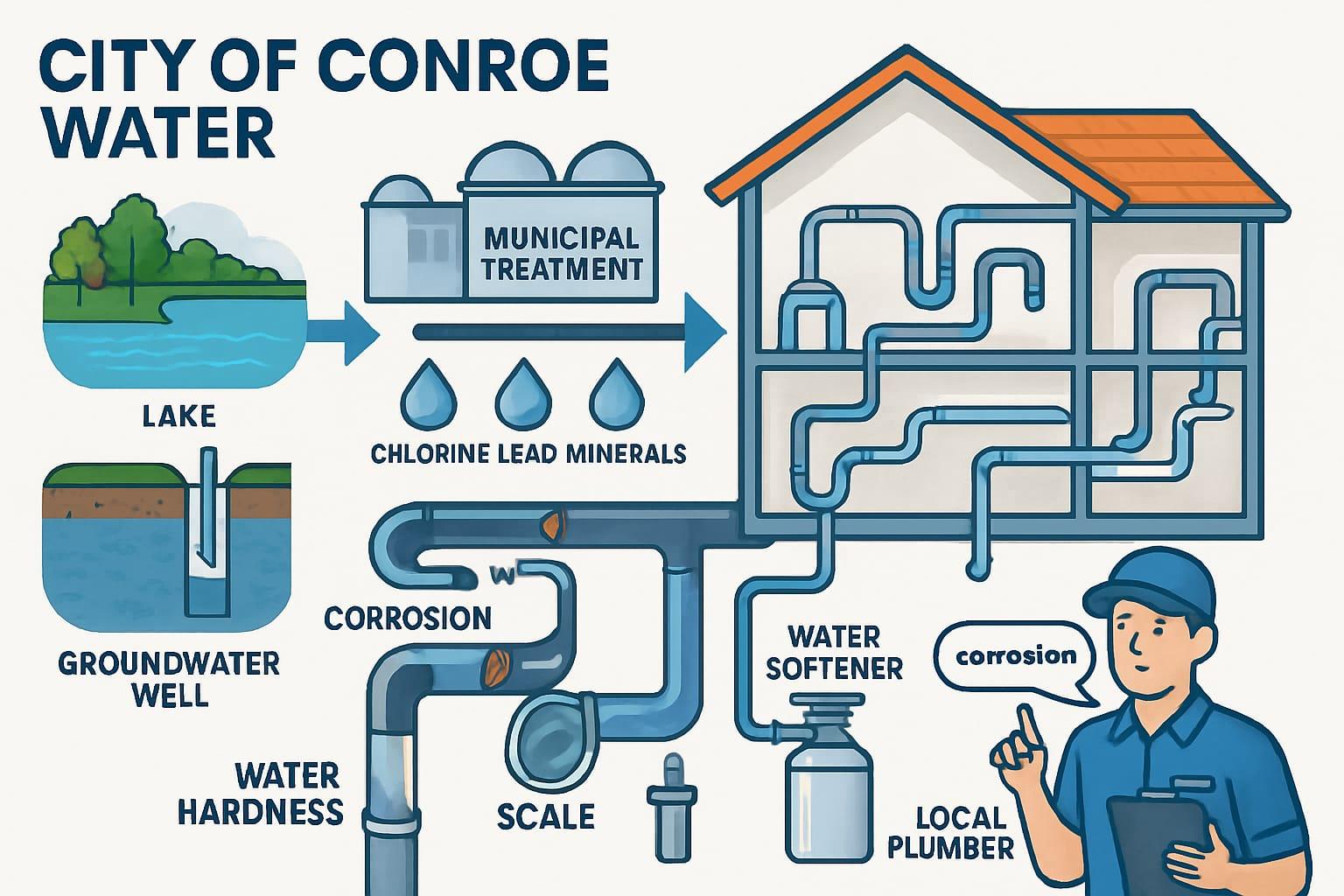
Probably not. We went through the latest reports for Conroe, The Woodlands’ MUDs, Magnolia, Montgomery, Willis, Oak Ridge North, Panorama Village, Tomball, the Spring-area districts, Splendora, New Caney and Porter. They cover lead, copper, chlorine and where the water comes from. Not one gives a hardness number.
That doesn’t mean your water is hard. It doesn’t mean it’s soft, either. It just means nobody’s written it down.
The one exception is Shenandoah. Its 2025 report lists total hardness at 12.9 ppm as calcium carbonate, which is very soft. A softener’s whole job is pulling calcium and magnesium out of the water, and at 12.9 there’s next to nothing for it to pull. If you live in Shenandoah and someone’s pitching you a softener, ask them what exactly it’s going to remove.
2. What are your faucets telling you?
Your house has been running its own water test for years. Hard water leaves a chalky white crust where it dries, so take a look at:
- the faucet aerators and the base of the faucet
- the little nozzles on your showerhead
- glass shower doors and dark tile
- glasses fresh out of the dishwasher
- the inside of your kettle or coffee maker
A little spotting here and there is just life. Heavy white buildup that’s back a week after you scrub it is worth testing for. Our hard water and scale page has more, and if your soap won’t lather, that’s another clue.
Two things that fool people:
| What you see | What it probably is | Will a softener fix it? |
|---|---|---|
| Spots on glass, but soft water on paper | Other dissolved solids (Shenandoah lists 376 ppm total dissolved solids) | No |
| Orange or brown stains | Iron, or rust from aging pipes | No |
| Heavy white crust that comes right back | Hardness | Yes |
3. Is it really the taste you’re after?
Lots of people who ask about softeners really just want better drinking water. If that’s you, here’s the part nobody mentions: a standard softener adds sodium. It swaps the hard minerals for it. That’s how ion exchange works.
Shenandoah’s water already has about 129 ppm of sodium before any softener touches it. If you’d like less salt in your coffee, not more, a softener moves you the wrong way.
What takes sodium out is reverse osmosis. It lives under the kitchen sink, runs water through a very fine membrane that holds back most dissolved salts, and feeds its own little faucet. You get good water for drinking and cooking without treating every gallon that goes to the toilets and the sprinklers. For a lot of homes around here, that’s the better fit.
4. Have you tested your own tap?
This is the one that decides it. A city report, when it says anything at all, is an average for the whole system. A water test at your faucet tells you hardness, dissolved solids, iron and more for your house.
If the numbers say hard water, a water softener is a fine answer, and we’ll tell you what it’ll take to keep it running (salt and the occasional service visit). If they say otherwise, we’ll tell you that too, whether the answer is RO at the sink, a filter, or nothing at all.
Have a plumbing problem like this?
We're a Marine veteran-owned plumbing company in Conroe. Tell us what's going on and we'll take it from there.