If you’re on a private well, nobody tests your water for you. That’s the first thing to know, and the reason this guide starts with how to test well water in Texas before it gets to filters. We’ll walk through what’s at stake, what’s in a well, what you can do yourself, and when it makes sense to call a local plumber.
Why Well Water Needs Your Attention
City customers get water that’s tested and monitored for them. With a private well, that job is yours. Texas doesn’t test a private well on your behalf, so the responsibility sits with the homeowner. Your county and the Texas Commission on Environmental Quality (TCEQ) are the places to ask about any local requirements that apply to your well.
Neglect costs you in ways you can see. Staining, cloudy water and a bad smell wear on your fixtures, your appliances and your patience, and the only way to know what’s causing them is to look at what’s actually in the water.
What Is in Well Water
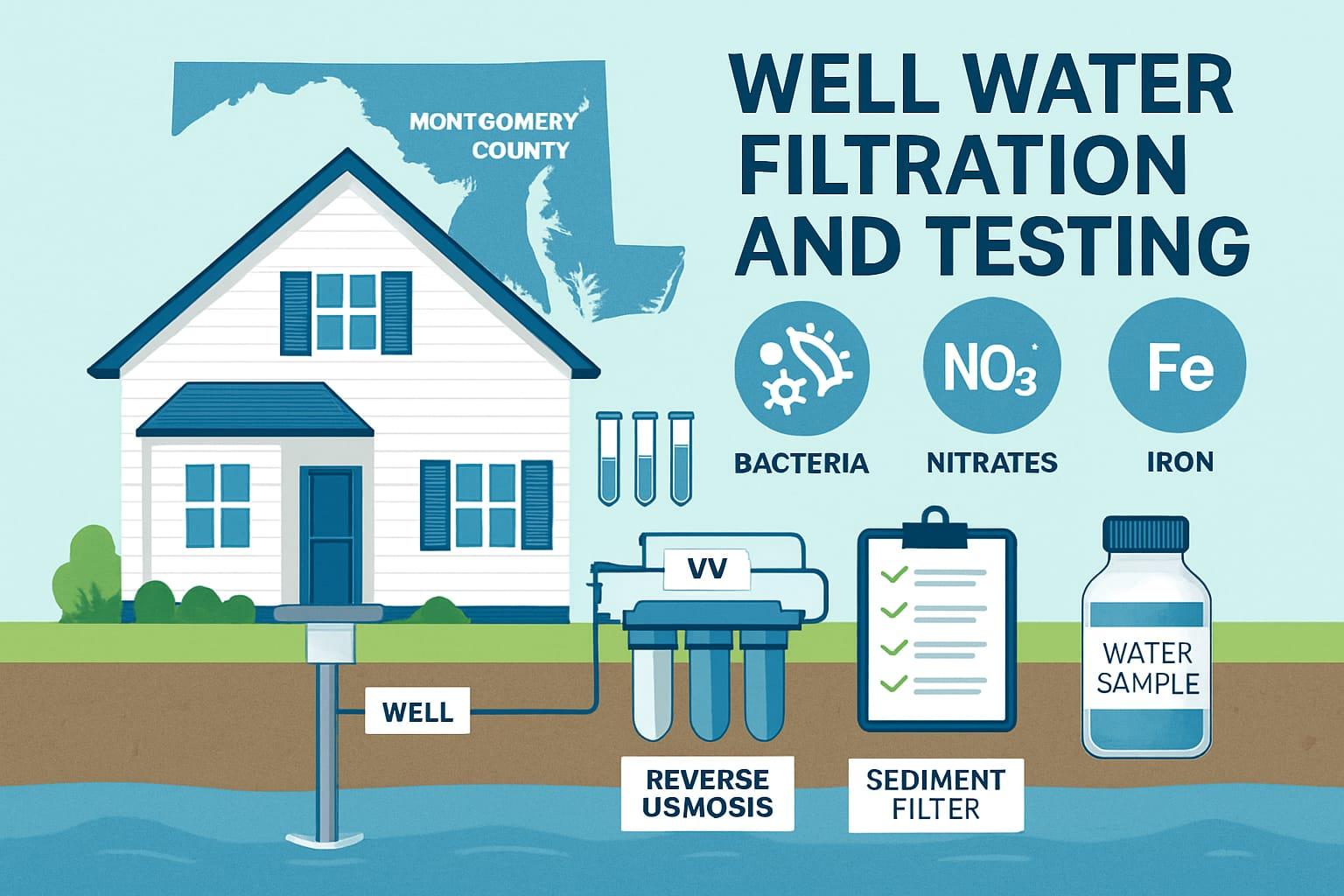
Wells here can pick up bacteria, iron, sulfur and sediment. Bacteria can come from nearby agricultural runoff, a failing septic system or a poorly built well. Iron and sulfur cause bad tastes and odors and can stain fixtures. Sediment clouds the water and can clog aerators, valves and appliance screens. Nitrates, which often come from agricultural runoff or failing septic systems, are another thing a good test looks for.
Different filters handle different problems, so it helps to know the main ones.
Sediment Filters
A sediment filter catches visible particles and protects every filter and fixture downstream of it. It works well alongside UV or reverse osmosis.
UV Disinfection
UV disinfection uses ultraviolet light to treat bacteria and viruses without adding chemicals. It doesn’t remove chemical contaminants or sediment, so it’s usually paired with other filtration.
Reverse Osmosis
Reverse osmosis (RO) pushes water through a semi-permeable membrane that traps dissolved solids, heavy metals and some organic compounds. RO gives you very good drinking water, but it usually needs a storage tank and regular filter changes.
How to Test and Maintain Your Well
You can do most of this yourself, and we’ll tell you where to stop.
- Test at least once a year. That’s the common recommendation, and it lets you catch trends or a new source of contamination early.
- Ask for total coliform and E. coli bacteria, nitrates, heavy metals and volatile organic compounds (VOCs).
- Use an accredited laboratory, so you can trust the results.
- Follow the lab’s sample collection and handling instructions to the letter. Sloppy sampling can give false positives or negatives.
- Retest after heavy Gulf rains or flooding near the wellhead, or whenever the taste, smell or look of the water changes.
- Change sediment and RO filters on the schedule the maker gives you.
Test first, buy equipment second. The results tell you which filter fits your water, and that keeps you from paying for a system that treats the wrong thing.
When It Is More Than Maintenance
Your senses usually notice a problem before a lab report does. Here is what we hear about, in the order you’d notice it.
What You’ll See
Water that leaves white spots and crusty buildup on faucets, showerheads and dishes points to hard water, which is common in our area. Orange or brown staining on fixtures, or cloudy water with sand or particles in it, usually means iron or sediment is getting through.
What You’ll Smell and Taste
If your tap water smells or tastes off, whether that’s a metallic taste, a rotten-egg smell or a chemical note, get it tested before you decide anything else.
What You’ll Feel
Filters that clog quickly and a drop in flow at the faucets often mean sediment is loading up your system faster than it should.
None of these tells you what’s in the water, only that it’s time to find out.
Choosing the Right Filtration and Testing Help
A few things are worth weighing.
- Expertise: Look for someone who knows water treatment and local requirements, with licensing you can verify.
- Reputation: Read reviews on more than one platform, and ask neighbors. In a county like ours, the good ones are known by name.
- Range: A provider that handles both testing and filtration can match a system to whatever the test finds, taking into account your household size, well depth and the contaminants in your water.
When to Call a Plumber for Well Water Treatment
You can handle the testing and the filter changes. When your results show a problem and you’re ready to treat the water, or when a simple fix didn’t hold, we’re a local, licensed master plumber, and Dean Stewart holds our Texas master plumber license. People also call us for a second opinion on what another company told them, and we’ll tell you straight if you don’t need what you were quoted.
Our plumber starts with your water-test results and your goals before recommending anything. For a whole house, whole-home water filtration treats the water where it enters the house, so every faucet and shower gets it, not just the kitchen tap. A water test first shows which filter fits your water. If your main concern is drinking water, a point-of-use reverse osmosis system at the kitchen sink may be enough, and we’ll help you weigh the two for your home.
Getting started is simple. Fill out the request form, pick an arrival window that works for you, and one of our plumbers comes out to you. We explain before we work, we respect your home, and we’ll leave it clean.
Hopefully you never need us, but if you do, we’re right here. Help is on the way in Montgomery County.
Have a plumbing problem like this?
We're a Marine veteran-owned plumbing company in Conroe. Tell us what's going on and we'll take it from there.