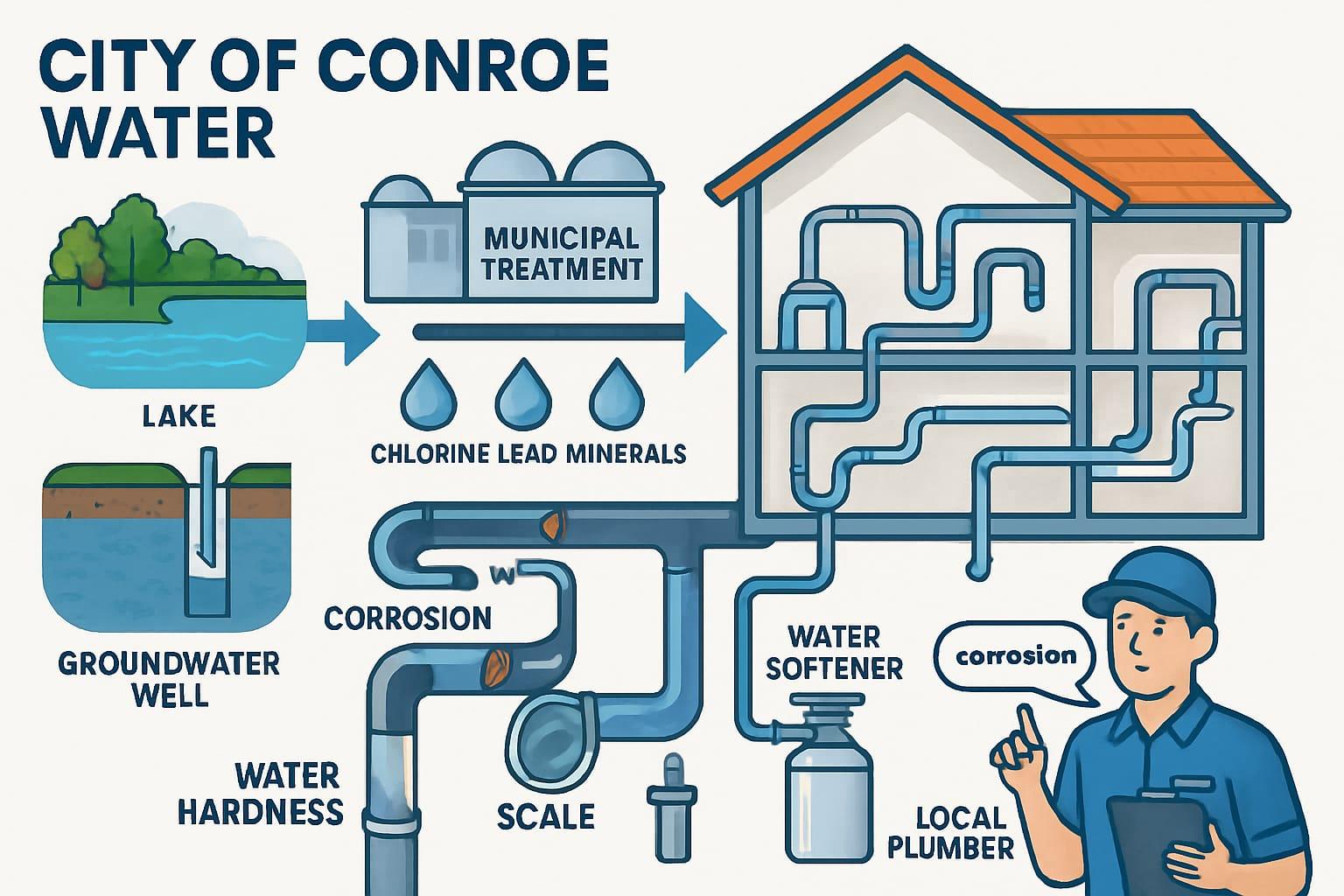
Picture the water on its way to your kitchen. It leaves the main under the street, runs through a short pipe to your meter, and then keeps going through more pipe, under the yard and into the walls, until it comes out of your faucet.
Everything up to the meter belongs to the water system. Everything after it belongs to you. Keep that line in mind, because it’s the whole story with these new “service line inventories.”
The city’s side: good news
Water systems now have to keep a list of what every service line is made of, and the ones around here have come back clean:
- Conroe and Tomball: no lead, no galvanized lines needing replacement, and no unknowns.
- Porter: Porter SUD has no lead or galvanized lines needing replacement.
- The Woodlands: SJRA, which supplies the MUDs, reports the same.
- Splendora: the city says it “has never used lead or lead containing materials for its water service lines.”
- Willis: no lead, but some lines are listed as “Galvanized Requiring Replacement.” You can look up your address on the city’s About Our Water page.
A couple of towns keep the full list instead of summarizing it. Panorama Village’s is at City Hall, and Magnolia’s is on the state’s Drinking Water Viewer (dwv.tceq.texas.gov, system TX1700020).
Your side: nobody’s checked it
Here’s the part the inventories can’t tell you. A clean city line says nothing about the pipe from your meter to your house, or the plumbing inside your walls. The city doesn’t own that pipe, so it isn’t on the list.
Same goes for the lead numbers in the water reports. Those come from samples at a set of homes around town, rolled up into one number for the whole system. Conroe’s, for example, was 0.0012 ppb, a long way under the action level of 15. That’s great to know. It still isn’t a test of your faucet.
Who should care
If your house went up after about 1980, you can probably relax. Most homes in Conroe, The Woodlands, Willis and Montgomery are newer than that.
If you’re in Oak Ridge North, Panorama Village or Porter Heights, it’s a different picture: about two-thirds of the homes in Oak Ridge North, and roughly half in the other two, were built before 1980. That’s when galvanized steel supply pipe was still common, and it’s worth knowing what’s in your walls.
Figuring out what you’ve got
Find where the water line comes into the house. It’s often near the meter, a hose bib or the water heater. Grab a magnet off the fridge and have a look:
| Pipe | What it looks like | Magnet |
|---|---|---|
| Copper | Penny-colored | Doesn’t stick |
| PEX | Plastic, often red, blue or white | Doesn’t stick |
| Galvanized steel | Dull gray, threaded fittings at the joints | Sticks |
| Lead | Soft, dull gray; shiny silver if you scratch it lightly with a key | Doesn’t stick |
Can’t tell, or can’t get to it? Any plumber can tell you by looking at the exposed pipe, and we’re happy to.
What galvanized pipe does over time
Galvanized pipe is steel with a zinc coating. Over the years the inside rusts and closes up, a bit like an old artery. You’ll usually notice it one of two ways:
- Low water pressure that’s crept down over the years, worst at the upstairs or far-end fixtures.
- Brown or orange water, often right when you open the hot tap.
If it turns out you have it
You don’t have to do anything tonight. The lasting fix is replacing it with copper or PEX, either the sections that are failing or the whole house at once, and whole-home repiping usually clears up the pressure and rust problems along the way.
If you’d like some peace of mind at the tap in the meantime, a filter certified for lead reduction at the kitchen sink is a sensible step. Check the product’s listing for lead reduction specifically, not just a general “filters your water” claim. A reverse osmosis system or whole-home filtration are other options. And for anything about the city’s water itself, the city’s notices are the ones to watch.
Have a plumbing problem like this?
We're a Marine veteran-owned plumbing company in Conroe. Tell us what's going on and we'll take it from there.